
NASA Mars rover mission update: what’s next?
Anúncios
The NASA Mars rover mission update highlights ongoing technological advancements and community involvement, enhancing our understanding of the planet and paving the way for future exploration.
The NASA Mars rover mission update brings thrilling news from the Red Planet, sparking curiosity about our exploration journey. Have you ever wondered what secrets the rovers have uncovered? Let’s dive into the latest findings and future missions that could reshape our understanding of Mars.
Anúncios
Current status of the Mars rovers
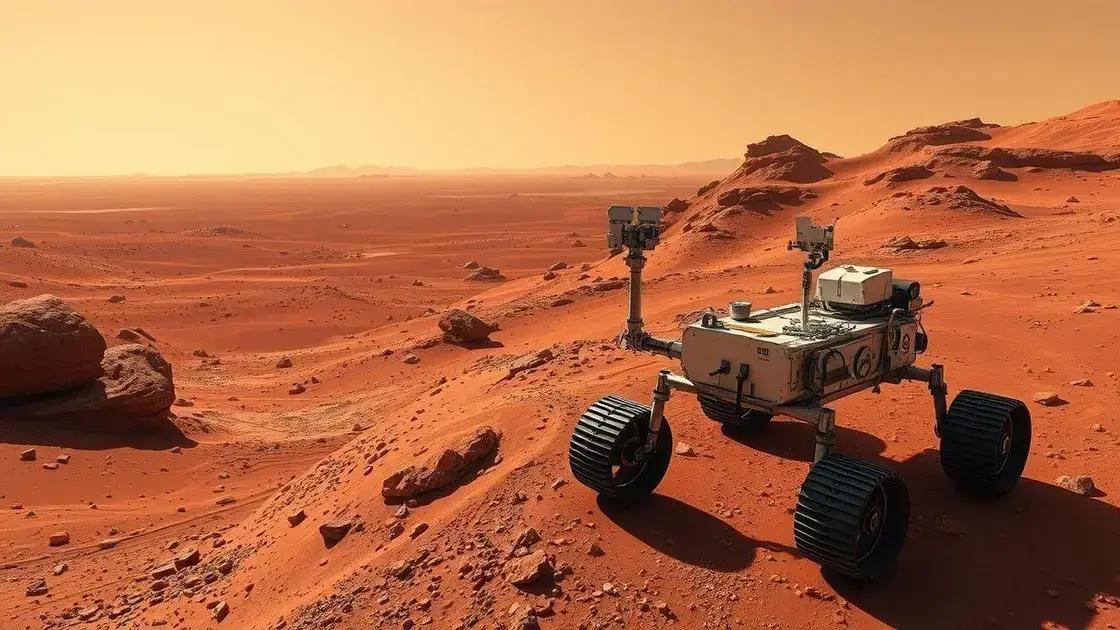
The current status of the Mars rovers showcases their significant contributions to our understanding of the Red Planet. As they navigate the Martian terrain, these rovers gather valuable data that helps scientists piece together the planet’s history.
Recently, both Curiosity and Perseverance have made remarkable progress. While Curiosity continues to explore Gale Crater, Perseverance is focused on the Jezero Crater.
Curiosity’s Latest Endeavors
Curiosity has been conducting scientific experiments and examining rock samples. These analyses can reveal signs of ancient microbial life:
Anúncios
- Investigating rock formations for mineral presence.
- Studying atmospheric conditions for potential habitability.
- Collecting data on radiation levels.
Meanwhile, Perseverance has a different objective. It aims to collect samples and test tools for future human missions. This rover is equipped with advanced technology, including:
- An array of scientific instruments to analyze Martian soil.
- The ability to produce oxygen from carbon dioxide.
- Advanced cameras to capture detailed images of the landscape.
The collaboration between both rovers enhances our understanding of Mars. By sharing information, they help scientists create a clearer picture of the planet’s climate and geology. It’s exciting to think about the ongoing discoveries awaiting us.
Both rovers continue their missions with support from teams on Earth. This ongoing communication allows for adjustments and new strategies in real-time. Staying updated on their findings is essential for those interested in space exploration.
The exploration of Mars is a crucial step toward future human habitation. As the rovers proceed, they lay the groundwork for what a mission to Mars could look like. Their efforts will ultimately pave the way for new frontiers in our quest to explore the universe.
Recent discoveries and findings
The recent discoveries and findings from Mars have captivated scientists and space enthusiasts alike. As the rovers continue their missions, they provide crucial insights into Mars’ environment and history.
One of the most exciting discoveries involves the detection of ancient river deltas. These features indicate that water once flowed on the surface. Evidence shows that:
- Rover images display layers of sediment, which suggest past water activity.
- Samples have revealed minerals that form in the presence of water.
- Scientists have analyzed rock formations that hint at a once habitable environment.
Another groundbreaking finding is the presence of organic molecules. These tiny compounds are essential for life and raise questions about past biological activity on Mars. The rovers have identified:
- Organic molecules within rock samples from ancient lake beds.
- Potential biosignatures that could indicate past life.
- Variations in organic matter that could suggest different environmental conditions over time.
Additionally, ongoing studies have focused on Martian climate. Understanding its past climate can help us predict its future. Recent data shows:
- Fluctuations in temperature over millions of years.
- Changes in atmospheric conditions that may have affected water availability.
- Evidence of seasonal weather patterns on Mars.
These findings significantly contribute to our understanding of Mars. The data collected not only helps us comprehend the planet’s past but also aids future missions aimed at searching for life. As new information emerges, excitement continues to build around what the rovers will discover next.
Upcoming missions to Mars

The upcoming missions to Mars promise to expand our knowledge about the planet and prepare for future human exploration. These missions aim to build upon the successes of current rovers and delve deeper into Mars’ mysteries.
One eagerly anticipated mission is NASA’s Artemis program. This initiative focuses on returning humans to the Moon and using it as a stepping stone for Mars missions. Plans involve:
- Testing new technologies that will support human life on Mars.
- Developing strategies for safe travel and landing on the Martian surface.
- Utilizing lessons learned from lunar missions to enhance planning for Mars.
Additionally, the European Space Agency (ESA) is collaborating with Roscosmos on the ExoMars mission, which will send an advanced rover named Rosalind Franklin to search for signs of past life. This mission will focus on:
- Analyzing soil samples from beneath the Martian surface.
- Examining the composition of organic matter.
- Identifying locations where life could have developed.
Another mission, the NASA Dragonfly, is planned for Titan, Saturn’s moon, but scientists are eager to apply any findings back to Mars. Understanding other celestial bodies helps in forming hypotheses about Mars. Future missions are set to use:
- Aerial vehicles similar to Dragonfly to explore Mars’ surface from different angles.
- Instruments capable of analyzing Martian soil and atmosphere in real-time.
- Innovative landing techniques to reach challenging terrains.
These upcoming missions are crucial for preparing humanity’s eventual journey to Mars. Each mission is interconnected, contributing unique data that will enhance our understanding and technology. As we await these launches, the excitement for interplanetary exploration continues to grow.
Technological advancements in space exploration
The technological advancements in space exploration are transforming our ability to explore planets like Mars. These innovations increase our chances of successful missions and help us gather more data from the cosmos.
One major breakthrough is the development of more efficient propulsion systems. These systems allow spacecraft to travel faster and further than ever before. For example:
- Ion propulsion systems use less fuel and enable longer missions.
- Solar sails harness sunlight for continuous acceleration.
- Chemical rockets are becoming more reliable and powerful.
Another area of advancement involves robotics. Rovers and landers are now equipped with sophisticated technology, allowing them to conduct scientific experiments autonomously. Recent examples include:
- Advanced AI algorithms that enable decision-making on the Martian surface.
- High-resolution cameras for capturing detailed images of the terrain.
- Robotic arms that can collect and analyze soil samples directly.
In addition, communication technologies have improved significantly. These advancements ensure we receive data from distant missions more reliably. Improvements include:
- Laser communication systems that provide higher data transmission rates.
- Satellite networks that enhance global connectivity.
- Real-time data transfer capabilities for immediate analysis.
Moreover, advancements in materials science play a critical role. New materials are being developed to withstand harsh conditions in space. These materials include:
- Heat-resistant ceramics for spacecraft re-entry.
- Lightweight composites for building durable structures.
- Radiation shielding materials to protect instruments and crew.
These technological innovations not only enhance our current missions but also prepare us for future endeavors, including potential human colonization of Mars. Each advancement brings us closer to understanding our place in the universe and the possibilities for life beyond Earth.
Community involvement in Mars research
Community involvement in Mars research has become an important aspect of space exploration. Engaging the public not only fosters interest in science but also harnesses collective knowledge and creativity.
One of the primary ways communities are involved is through citizen science projects. These initiatives allow everyday people to contribute to scientific research. For example:
- Zooniverse enables volunteers to classify images from Mars rovers and help identify interesting geological features.
- Projects like Planet Four invite the public to analyze images of Mars’ polar regions to find changing features.
- Through Astrobiology Magazine, individuals can engage in discussions and learn about the latest discoveries concerning potential life on Mars.
In addition to citizen science, educational programs play a crucial role. Schools and universities often collaborate with space agencies to create workshops and outreach activities. These programs aim to:
- Inspire students to pursue careers in STEM fields.
- Provide hands-on experiences with Mars-related projects.
- Encourage young minds to think critically about space exploration.
Moreover, social media platforms have become valuable tools for connecting scientists with the public. Researchers frequently share updates, images, and findings from Mars missions, inviting questions and conversations. This interaction enhances transparency and builds trust within the scientific community. People can:
- Follow accounts like NASA’s Mars Exploration Program to stay updated.
- Engage directly with scientists during live Q&A sessions about ongoing research.
- Share their excitement and insights on platforms such as Twitter and Instagram.
Community-driven initiatives foster a sense of belonging in science. As people become more involved in Mars research, they feel connected to the mission of exploring new frontiers. This collaborative approach not only enriches scientific inquiry but also inspires the next generation of explorers and innovators.
FAQ – Frequently Asked Questions about Mars Exploration
What is the role of community involvement in Mars research?
Community involvement enhances Mars research by allowing the public to participate in scientific projects, contributing valuable insights and data.
How can I participate in citizen science projects related to Mars?
You can participate by joining projects like Zooniverse or Planet Four, where you can help classify images and data collected by Mars rovers.
What advancements are being made in Mars exploration technologies?
Advancements include improved propulsion systems, sophisticated robotics, and better communication technologies, all aimed at enhancing exploration missions.
What is the significance of upcoming Mars missions?
Upcoming missions are crucial for gathering data, testing new technologies, and preparing for potential human exploration of Mars in the future.

Lara Barbosa has a degree in Journalism, with experience in editing and managing news portals. Her approach combines academic research and accessible language, turning complex topics into educational materials of interest to the general public.