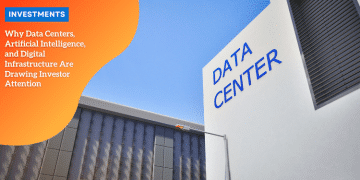
Why Investors Are Watching AI Infrastructure and Data Center Spending in the U.S.
Anúncios
As a result, investors are paying increasing attention to AI infrastructure and data center spending in the U.S. The opportunity is not limited to companies developing AI models. A much broader group of businesses may benefit from the enormous physical infrastructure required to operate increasingly powerful AI systems.
In the first half of 2026, North American data center demand reached a record 25 gigawatts (GW) of absorption, according to JLL, roughly twice the level seen a year earlier. At the same time, vacancy remained around 1%, highlighting how quickly demand is growing relative to available capacity.
For investors, however, rapid growth also creates risks. Data centers require enormous amounts of capital, electricity, land, water, specialized equipment, and financing. Power availability has become one of the industry’s biggest constraints, while rising construction costs and lengthy grid-connection timelines can affect project profitability.
Anúncios
In this comprehensive guide, readers will learn:
- Why AI is driving data center investment across the U.S.
- How much data center demand is growing in 2026
- Why electricity has become a critical investment theme
- Which infrastructure industries could benefit
- Why Texas, Virginia, and other U.S. markets are attracting investors
- How AI infrastructure is changing real estate
- Why financing and interest rates matter
- What risks investors should consider
- What to watch as AI infrastructure spending continues
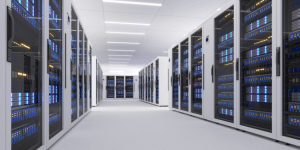
AI Is Creating a New Infrastructure Investment Cycle
The growth of generative AI and other advanced computing applications requires significantly more computing capacity.
AI models depend on specialized processors, high-performance servers, networking equipment, storage systems, and cooling infrastructure. These systems need to operate continuously, meaning that companies cannot simply add more software capacity without expanding the physical infrastructure supporting it.
Anúncios
This has created a new investment cycle.
Instead of looking only at AI software companies, investors are increasingly examining the companies and industries that provide the physical foundation for AI.
That includes:
- Data center operators
- Utilities
- Power generators
- Semiconductor manufacturers
- Electrical equipment companies
- Cooling-system providers
- Fiber and telecommunications companies
- Construction firms
- Engineering companies
- Real estate developers
- Energy-storage companies
The result is an increasingly interconnected AI infrastructure ecosystem.
Data Center Demand Is Accelerating
One of the strongest reasons investors are watching the sector is the extraordinary level of demand.
JLL reported that North American data center absorption reached 25 GW during the first half of 2026, double the level from a year earlier and five times the amount recorded two years earlier. AI companies, hyperscalers, and newer cloud providers were competing for limited capacity.
This demand is occurring while available capacity remains extremely limited.
CBRE reported that construction activity across eight primary North American data center markets increased 24.8% during the first half of 2026, reaching a record 7,481 MW of capacity under construction. Even with that construction boom, more than 80% of capacity was already preleased, leaving less than six months of available supply.
For investors, this creates an important dynamic.
More construction does not necessarily mean the market is becoming oversupplied. In many locations, demand is growing faster than new capacity can be delivered.
Why Data Centers Are Becoming Valuable Real Estate
Data centers are increasingly being treated as a specialized form of infrastructure real estate.
Unlike traditional office buildings or shopping centers, data centers depend heavily on access to electricity and telecommunications infrastructure.
A location with sufficient land but inadequate power may not be commercially useful for a large AI facility.
Consequently, investors are looking for locations that combine:
- Reliable electricity
- Available land
- Fiber connectivity
- Transmission infrastructure
- Favorable regulations
- Tax incentives
- Access to skilled workers
- Low disaster risk
- Water or alternative cooling resources
This is changing how developers evaluate real estate.
Power Availability Has Become a Major Investment Issue
Perhaps the biggest constraint facing the data center industry is electricity.
CBRE’s 2026 investor survey found that power availability was the industry’s top challenge for the third consecutive year. The survey also found that more than half of investors expected to increase their data center capital allocations in 2026, while 55% expected their data center buying activity to increase by more than 10%.
This means investors are not simply asking where they can build a data center.
They are increasingly asking:
Where can they obtain enough electricity to operate it?
That question can determine whether a project can be completed on schedule.
AI Is Increasing U.S. Electricity Demand
The connection between AI infrastructure and the U.S. energy market is becoming increasingly important.
The International Energy Agency projects that U.S. electricity demand will grow by nearly 2% per year through 2030, with data centers accounting for approximately half of that increase. The United States is expected to add more than 420 terawatt-hours of electricity demand over the five-year period.
That represents a significant shift.
For decades, electricity demand in many advanced economies grew relatively slowly. The rapid expansion of AI and data centers is helping create a new source of electricity demand.
As a result, investors are increasingly looking beyond data center buildings themselves.
Utilities Could Become Part of the AI Investment Story
The expansion of AI infrastructure requires more electricity generation and transmission capacity.
This could create opportunities for companies involved in:
- Natural gas generation
- Renewable energy
- Nuclear power
- Battery storage
- Transmission lines
- Electrical equipment
- Transformers
- Grid management
- Power infrastructure
The IEA expects renewables and natural gas to play major roles in meeting rising data center electricity demand, while nuclear power and other technologies could also contribute.
For investors, this means the AI infrastructure theme can extend into the energy sector.
The Grid Is Becoming an Investment Bottleneck
Building a data center can take several years, but connecting a large facility to the electricity grid can take even longer.
The IEA has emphasized that the energy system requires longer lead times than the technology sector to plan and construct infrastructure. This creates a potential bottleneck between the speed of AI adoption and the speed at which electricity infrastructure can be developed.
CBRE also reports that some large AI campuses now require hundreds of megawatts of power and that projects requiring new high-voltage transmission or additional generation can face interconnection timelines of 24 to 48 months or more.
This is one reason investors are increasingly interested in companies that can help solve power-related infrastructure problems.
Texas Is Emerging as a Major Data Center Market
Texas has become one of the most closely watched markets for data center development.
CBRE’s 2026 investor survey identified Dallas-Fort Worth as the most attractive North American data center market, with 78% of surveyed investors selecting it. Northern Virginia followed at 72%.
Texas offers several characteristics that appeal to developers, including:
- Large amounts of available land
- Competitive electricity costs
- A deregulated power market
- Strong fiber infrastructure
- Relatively limited natural disaster exposure
- Business-friendly policies
- Significant potential for new power generation
As AI infrastructure expands, these characteristics can become increasingly valuable.
Northern Virginia Remains a Critical Hub
Northern Virginia remains one of the most important data center markets in the world.
CBRE reported that Northern Virginia had approximately 4,496.5 MW of existing inventory in the first half of 2026 and recorded the largest net absorption among primary markets, at 467.6 MW. Its vacancy rate fell to only 0.2%.
This demonstrates the strength of established technology infrastructure markets.
However, extremely tight availability can also encourage developers and investors to look for new markets where land and electricity can be secured more easily.
New U.S. Markets Are Becoming More Important
The data center industry is increasingly expanding beyond traditional hubs.
JLL reported that frontier markets accounted for 77% of the North American construction pipeline in 2026. This indicates that developers are searching for new locations where large amounts of electricity, land, and infrastructure can be assembled.
Markets in states such as Texas, Ohio, Louisiana, Indiana, and the Carolinas have attracted increasing attention.
For investors, emerging markets can offer both opportunity and risk.
The potential advantage is that land and power may be easier to secure.
The disadvantage is that infrastructure, permitting, workforce availability, and community acceptance may be less developed.
Data Centers Are Creating Opportunities for Construction Companies
The AI infrastructure boom requires enormous amounts of physical construction.
Projects need:
- Buildings
- Electrical systems
- Cooling systems
- Backup generators
- Substations
- Transformers
- Fiber connections
- Security systems
- Roads
- Water infrastructure
- Specialized engineering
As a result, construction and engineering companies can become indirect beneficiaries of data center investment.
However, investors need to distinguish between companies that receive temporary construction contracts and businesses that can generate sustainable long-term revenue from the broader infrastructure cycle.
Fiber Networks Are Another Important Piece
AI systems also depend on high-speed connectivity.
Data centers must communicate with other facilities, cloud platforms, users, and computing clusters.
CBRE reported that more than 20,000 route miles of new fiber projects were announced in North America during 2026, with new infrastructure being developed to connect emerging AI markets and hyperscale workloads.
This creates another potential investment theme.
AI infrastructure is therefore not simply about buildings filled with servers. It also depends on the network connecting those facilities.
Cooling Technology Could Become Increasingly Important
AI servers generate substantial amounts of heat.
As computing density increases, traditional cooling systems may become less effective or less efficient for certain applications.
This has increased interest in advanced cooling technologies, including liquid cooling and other high-density cooling systems.
For investors, this creates another layer of the AI infrastructure opportunity.
Companies that can improve energy efficiency, cooling performance, and server density could become increasingly relevant as data center operators attempt to control operating costs.
Financing Is Becoming a Major Consideration
Data centers require substantial upfront investment.
Projects can cost billions of dollars, especially when they include large campuses, power infrastructure, land acquisition, and specialized equipment.
This means financing conditions can have a major effect on the industry’s growth.
JLL reported that permanent financing for data center development could reach approximately $700 billion through 2028, while AI-related bond issuance reached about $250 billion during the first half of 2026.
This demonstrates how closely AI infrastructure is becoming connected to capital markets.
Higher Interest Rates Could Affect Data Center Investments
The investment opportunity is significant, but financing costs matter.
When interest rates are high, developers generally pay more to finance new projects.
This can affect:
- Project returns
- Construction budgets
- Debt service
- Property valuations
- Development timelines
- Investor appetite
CBRE noted that nearly 60% of surveyed investors viewed lower debt costs as a potential tailwind for the data center industry, highlighting how financing conditions remain important.
Therefore, investors should not evaluate AI infrastructure solely by looking at demand.
They also need to consider the cost of capital.
AI Infrastructure Could Benefit the U.S. Economy
The data center boom can create economic activity beyond technology companies.
New facilities can generate demand for:
- Construction workers
- Electricians
- Engineers
- Equipment manufacturers
- Utility workers
- Security professionals
- Network specialists
- Maintenance workers
Data center projects can also generate tax revenue for local governments and encourage investment in roads, utilities, and other infrastructure.
However, the benefits are not evenly distributed.
Communities must also consider electricity demand, water use, land requirements, noise, environmental impacts, and infrastructure costs.
Community Opposition Is a Growing Risk
One of the most interesting challenges for investors is community acceptance.
JLL reported a significant gap between support for U.S. leadership in artificial intelligence and support for data center development within local communities. The organization found that 79% of Americans supported U.S. AI leadership, while only 14% supported data center development in their own community.
This difference could become increasingly important.
A project can make economic sense on paper but still face delays if local residents oppose it.
Investors therefore need to consider permitting and community relations alongside financial projections.
Water and Environmental Concerns Matter Too
Electricity is not the only infrastructure issue.
Data centers can require significant cooling resources, particularly in areas with large concentrations of computing infrastructure.
Investors and developers therefore need to evaluate:
- Water availability
- Cooling technology
- Local environmental regulations
- Energy sources
- Community concerns
- Long-term operating costs
Projects that can achieve high computing performance while using less energy and water may become increasingly attractive.
The AI Infrastructure Market Is Not Risk-Free
The growth of AI infrastructure does not guarantee that every investment will succeed.
Several risks deserve attention.
AI Demand Could Change
AI adoption is growing rapidly, but technology markets can change quickly.
If AI applications become significantly more efficient, companies may need fewer servers for certain workloads.
Construction Costs Could Rise
Labor shortages, equipment costs, tariffs, energy prices, and supply-chain constraints can increase project expenses.
Power Delays Could Affect Returns
A completed data center without sufficient electricity cannot operate at full capacity.
Interest Rates Could Remain High
Higher financing costs can reduce project profitability.
Regulation Could Change
Local, state, and federal rules regarding energy, environmental impacts, land use, and data centers can affect development timelines.
Technology Could Become More Efficient
More efficient chips, software, and cooling systems could reduce the amount of infrastructure required for certain AI workloads.
Why Investors Are Looking Beyond AI Stocks
The AI investment story is increasingly broader than publicly traded AI software and semiconductor companies.
Investors are examining the entire infrastructure ecosystem.
This can include exposure to:
- Data center real estate
- Utilities
- Power generators
- Semiconductor equipment
- Electrical components
- Construction
- Fiber networks
- Cooling technology
- Energy storage
- Industrial equipment
This broader approach reflects a simple reality:
AI cannot operate without physical infrastructure.
What Investors Should Watch in 2026
Several indicators could help investors evaluate whether the AI infrastructure boom remains sustainable.
Data Center Leasing
Continued strong leasing would indicate that demand remains high.
Construction Pipeline
Investors should monitor how much capacity is being built and how quickly projects are completed.
Vacancy Rates
Extremely low vacancy can indicate strong demand but may also signal supply constraints.
Electricity Availability
Access to reliable power could become one of the most important competitive advantages for data center developers.
Capital Costs
Interest rates and credit-market conditions can significantly affect project economics.
AI Company Capital Spending
Spending by major technology companies can provide clues about future infrastructure demand.
Power Infrastructure Investment
Growth in transmission, generation, storage, and electrical equipment could indicate that the broader AI infrastructure ecosystem is expanding.
The Bigger Picture for American Investors
The AI infrastructure boom is becoming one of the most significant capital investment stories in the U.S. economy.
Data centers are creating demand for real estate, electricity, construction, networking, cooling systems, semiconductors, and financial capital.
The scale of the electricity requirement illustrates just how significant the transformation could be. The IEA expects U.S. data centers to account for approximately half of U.S. electricity demand growth through 2030.
At the same time, the industry faces real constraints.
Power availability, grid connections, financing costs, construction capacity, environmental concerns, and community opposition could all determine which projects are ultimately successful.
Final Thoughts
Investors are watching AI infrastructure and data center spending in the U.S. because artificial intelligence is creating demand for an enormous physical infrastructure network.
The opportunity extends well beyond the companies developing AI software. Data center operators, utilities, construction companies, semiconductor suppliers, electrical equipment manufacturers, fiber networks, cooling providers, and energy companies can all play important roles in supporting the AI economy.
The numbers are already significant. North American data center demand reached a record 25 GW of absorption in the first half of 2026, while construction capacity also reached record levels.
Nevertheless, investors should not assume that rapid growth automatically means easy profits.
The most valuable projects may ultimately be those with reliable access to electricity, efficient technology, strong connectivity, manageable financing costs, and community support.
As AI adoption continues to expand, the central investment question may gradually shift from “Who will build the best AI?” to “Who will provide the infrastructure needed to power it?”
That question could remain one of the most important themes for U.S. investors throughout the rest of 2026 and into the years ahead.

Emilly Correa has a degree in journalism and a postgraduate degree in Digital Marketing, specializing in Content Production for Social Media. With experience in copywriting and blog management, she combines her passion for writing with digital engagement strategies. She has worked in communications agencies and now dedicates herself to producing informative articles and trend analyses.