Why Americans Are Paying More Attention to Emergency Savings as Household Affordability Becomes Tighter
Anúncios
Although inflation has slowed considerably from its 2022 peak, the overall price level remains much higher than it was several years ago. At the same time, many households are still managing expensive housing, healthcare, transportation, food, insurance, and debt payments.
This combination is making emergency savings more than just a long-term financial goal. For many Americans, having accessible cash can determine whether an unexpected expense becomes a temporary inconvenience or turns into additional debt.
Recent surveys suggest that a large portion of Americans still do not have enough savings to comfortably handle a financial shock. The Federal Reserve’s 2025 household survey found that 55% of adults said they had savings set aside to cover three months of expenses, unchanged from 2024 and below the 59% reported in 2021.
Anúncios
Meanwhile, Bankrate’s 2026 Emergency Savings Report found that only 47% of Americans said they had sufficient liquidity or access to funds to cover a $1,000 emergency expense.
As affordability remains a concern, emergency savings are increasingly being viewed as a financial buffer against the unexpected.
In This Comprehensive Guide, Readers Will Learn:
- Why emergency savings have become more important in 2026
- How inflation and household expenses affect saving ability
- How much Americans currently have saved for emergencies
- Why a $1,000 emergency can create financial stress
- The relationship between emergency savings and credit card debt
- Why income matters as much as spending when building savings
- How emergency funds can reduce reliance on expensive borrowing
- Where Americans can keep emergency savings
- How to build an emergency fund when money is tight
- What households should prioritize before the end of 2026
Why Emergency Savings Matter More When Affordability Is Tight
An emergency fund is money specifically reserved for unexpected expenses or financial disruptions.
Anúncios
The Consumer Financial Protection Bureau describes emergency savings as a cash reserve that can be used for situations such as car repairs, home repairs, medical expenses, or a loss of income.
The basic idea is simple: instead of paying for an unexpected expense with a credit card or loan, a household can use money that has already been set aside.
This can be particularly valuable when borrowing costs are high.
For example, a $1,500 car repair may be manageable if a household has enough savings available. Without savings, the same repair could require a credit card balance that remains outstanding for months.
The emergency itself may be temporary, but the debt created to pay for it can last much longer.
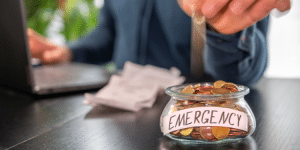
Many Americans Still Do Not Have Three Months of Expenses Saved
The traditional recommendation is to maintain several months of essential expenses in an emergency fund. However, the reality for many households is considerably different.
According to the Federal Reserve’s 2025 Survey of Household Economics and Decisionmaking, 55% of adults reported having rainy-day savings sufficient to cover three months of expenses if they lost their primary source of income.
That means a substantial share of Americans do not have that level of financial protection.
The situation also varies considerably depending on income and household circumstances.
Someone with stable employment, relatively low housing costs, and two incomes may need a smaller cash reserve than a single-income household with a mortgage, children, or significant medical expenses.
There is therefore no single emergency-fund number that works for everyone.
A $1,000 Emergency Can Still Be a Major Financial Challenge
One of the clearest signs of financial pressure is how households would handle a relatively modest emergency.
Bankrate’s 2026 survey found that only 30% of Americans said they would use savings to pay for a $1,000 or larger unexpected expense. Another 17% said they would rely on regular income or cash flow.
Meanwhile, approximately one-third said they would use some form of debt, including credit cards, borrowing from family or friends, or a personal loan.
That creates an important financial distinction.
A household may technically be able to handle a $1,000 emergency, but that does not necessarily mean it can handle it without financial consequences.
Using credit to pay the bill can solve the immediate problem while creating a new monthly obligation.
Inflation Is Still Making Saving More Difficult
One of the biggest obstacles to emergency savings is not necessarily a lack of financial discipline.
It is the cost of maintaining everyday life.
Bankrate reported that 54% of Americans said inflation and rising prices were causing them to save less for emergencies.
Even though inflation has slowed from its earlier highs, slower inflation does not mean prices have returned to previous levels.
Groceries, housing, utilities, insurance, transportation, and healthcare can still consume a significant portion of household income.
For families already using most of their paycheck for essential expenses, finding another $200 or $300 per month to place into savings may be unrealistic.
This is why emergency savings should be viewed within the broader context of household affordability.
Higher Income Can Make Saving Easier
Cutting expenses is often presented as the main solution to building an emergency fund.
However, recent data suggests that income growth can be equally important.
Bankrate found that households whose emergency savings increased were significantly more likely to report increased household earnings. Among respondents who had more emergency savings, 47% reported an increase in household earnings over the previous year.
This highlights an important reality:
There is a limit to how much a household can save by cutting expenses if most of its income is already committed to necessities.
For some Americans, increasing income through overtime, a second job, freelancing, career advancement, or other income sources may have a larger effect than cutting small discretionary expenses.
However, additional income does not automatically lead to greater savings. Households still need a system for directing part of that income toward financial reserves.
Emergency Savings and Credit Card Debt Are Closely Connected
Another reason Americans are paying closer attention to emergency funds is the relationship between savings and debt.
Bankrate’s 2026 report found that 29% of Americans had more credit card debt than emergency savings, while 44% said they had more emergency savings than credit card debt.
This creates a difficult choice for households.
Should extra money go toward paying down credit card debt or building emergency savings?
The answer can vary.
A household with no savings at all may benefit from establishing a small emergency reserve before aggressively paying down debt. Otherwise, the next unexpected expense could simply be placed on the credit card again.
Once a basic cash buffer exists, directing more money toward high-interest debt can become a stronger priority.
The goal is to avoid a cycle in which every emergency creates new debt.
Why an Emergency Fund Is Different From Regular Savings
Not all savings serve the same purpose.
A household might have money saved for:
- A vacation
- A new car
- A home down payment
- Holiday spending
- Education
- Retirement
- Emergency expenses
An emergency fund should generally be separated from money intended for planned purchases.
This makes it psychologically and practically easier to protect the money for situations that genuinely require it.
The CFPB recommends thinking about the types of unexpected expenses a household has experienced in the past when determining an appropriate emergency savings goal.
For example, someone who owns an older vehicle may need a larger emergency reserve for repairs than someone who relies primarily on public transportation.
How Much Should Americans Keep in Emergency Savings?
The commonly cited goal is three to six months of essential expenses, but that should not discourage people who are starting from zero.
A more practical approach can involve several stages.
First Goal: A Small Cash Buffer
The first objective may be simply reaching a few hundred dollars.
This amount will not cover every possible emergency, but it can help with smaller expenses such as:
- Car repairs
- Medical copays
- Appliance repairs
- Emergency travel
- Insurance deductibles
- Unexpected household bills
Second Goal: $1,000 or More
Once a household has a basic buffer, reaching $1,000 can provide greater protection against common financial shocks.
This is particularly meaningful given how many Americans report difficulty covering a $1,000 emergency from savings.
Third Goal: One Month of Essential Expenses
After reaching $1,000, households can work toward one full month of essential expenses.
This creates a more substantial cushion if income temporarily falls.
Long-Term Goal: Three to Six Months
For households with stable employment and predictable expenses, three months of essential costs can be an important milestone.
Households with variable income, one primary earner, significant medical expenses, or other financial risks may prefer a larger reserve.
Where Should Emergency Savings Be Kept?
Emergency savings should generally prioritize accessibility and safety over investment returns.
A high-yield savings account can be an option because it combines relatively easy access with the potential to earn interest.
Other options may include:
- Traditional savings accounts
- High-yield savings accounts
- Money market deposit accounts
- Short-term Treasury securities for appropriate portions of savings
However, an emergency fund should not normally be concentrated in volatile investments such as individual stocks or cryptocurrencies.
The purpose of emergency savings is not to maximize returns.
It is to make sure money is available when it is needed.
Why Liquidity Matters
An emergency fund is most useful when a person can access it quickly.
Imagine that a household needs $2,000 immediately for a medical bill or major vehicle repair.
If the money is invested in an asset that has fallen sharply in value, selling it could lock in a loss.
By contrast, cash or an accessible deposit account can generally be used without depending on market conditions.
This is why emergency savings and long-term investments serve different purposes.
A retirement account may be valuable for the future, but it is generally not the first place a household should look for money to pay an ordinary emergency.
Emergency Savings Can Reduce Reliance on Buy Now, Pay Later
The Federal Reserve has also highlighted the connection between financial liquidity and Buy Now, Pay Later usage.
Its August 2026 Consumer & Community Context analysis found that BNPL use was more common among adults with limited savings. Usage was 31% among adults whose largest emergency expense payable only from savings was less than $100, compared with 8% among those able to cover an emergency expense of $2,000 or more using savings.
This does not mean every BNPL user is financially vulnerable.
However, the relationship suggests that limited emergency liquidity can push households toward alternative forms of borrowing when unexpected expenses occur.
Building savings can therefore provide an additional layer of protection against short-term financing.
How Families Can Build Savings When Money Is Tight
Building an emergency fund does not require immediately saving thousands of dollars.
A smaller, consistent strategy may be more realistic.
Automate Small Transfers
A household could automatically transfer a fixed amount from checking to savings after each paycheck.
Even $20 or $25 at a time can create progress.
Save Part of Unexpected Income
Tax refunds, bonuses, overtime, cash gifts, and other irregular income can provide opportunities to strengthen emergency savings without reducing regular monthly spending.
Keep Emergency Savings Separate
A separate savings account can reduce the temptation to spend the money on everyday purchases.
Start With the Highest-Risk Expenses
Households can identify the expenses most likely to create financial problems.
For example:
- Vehicle owners may prioritize car repairs.
- Renters may prioritize a rent buffer.
- Homeowners may prepare for maintenance costs.
- Families may consider medical deductibles.
- Freelancers may need a larger income-replacement reserve.
Increase Savings When Income Rises
If a worker receives a raise, they do not necessarily need to increase spending by the full amount.
Directing part of the additional income toward savings can gradually strengthen the household’s financial position.
What About Paying Down Debt First?
This is one of the most common questions surrounding emergency savings.
If a household has high-interest credit card debt, paying it down can provide a guaranteed financial benefit by reducing future interest charges.
But maintaining no emergency savings at all can create another problem.
For example, someone could pay an extra $500 toward a credit card and then face a $700 emergency the following week. Without cash reserves, the household may need to use the credit card again.
A balanced approach can therefore make sense:
- Establish a small emergency buffer.
- Attack high-interest debt.
- Continue increasing emergency savings.
- Build toward several months of essential expenses.
The exact balance depends on income, debt costs, job stability, and household needs.
Why Emergency Savings Matter During Job Loss
Emergency savings become especially important when the unexpected event is not a single bill but a loss of income.
A household can often find a way to absorb a $500 repair.
Replacing several months of lost wages is much more difficult.
The Federal Reserve reported that 55% of adults had enough rainy-day savings to cover three months of expenses in 2025.
For households without that cushion, unemployment can quickly lead to difficult choices involving housing, utilities, food, healthcare, and debt payments.
Emergency savings cannot eliminate the financial consequences of job loss, but they can provide additional time to find new employment or adjust the household budget.
What Americans Should Watch as Affordability Remains Tight
Emergency savings are likely to remain a major personal-finance topic through the rest of 2026.
Americans should pay attention to several factors:
Household Income
Wage growth, employment changes, overtime opportunities, and layoffs can directly affect the ability to save.
Housing Costs
Rent and mortgage payments are among the largest expenses for many households. Changes in housing costs can dramatically affect how much money remains available for savings.
Credit Card Balances
High-interest debt can compete directly with emergency-fund contributions.
Consumer Prices
Even moderate inflation can gradually reduce the amount of disposable income available for savings.
Interest Rates on Savings
Changes in interest rates can affect the returns available on savings accounts and other cash-management products.
Employment Stability
Households dependent on one income or working in industries experiencing layoffs may want to consider a larger emergency reserve.
A Simple Emergency Savings Plan for the Rest of 2026
Americans who want to strengthen their financial position before the end of the year can start with a straightforward plan.
Step 1: Calculate essential monthly expenses.
Focus on housing, food, utilities, transportation, insurance, healthcare, and minimum debt payments.
Step 2: Identify the current emergency balance.
Do not include retirement accounts or money already allocated for other goals.
Step 3: Choose a realistic first target.
For someone starting from zero, $500 or $1,000 may be more achievable than immediately targeting six months of expenses.
Step 4: Automate contributions.
Set up recurring transfers that happen automatically after income arrives.
Step 5: Direct occasional extra income toward savings.
Use bonuses, tax refunds, overtime, or other unexpected income strategically.
Step 6: Review the fund every few months.
As household expenses increase, the emergency-fund target may need to increase as well.
Final Thoughts
Emergency savings are becoming more important for Americans because household affordability is about more than the inflation rate alone.
Even when inflation slows, families can still face elevated prices for housing, food, transportation, insurance, healthcare, and other necessities. When most of a paycheck is already committed to these expenses, an unexpected bill can quickly create financial stress.
The latest data shows why the issue deserves attention. The Federal Reserve found that 55% of adults had savings to cover three months of expenses in 2025, while Bankrate found that fewer than half of Americans reported having sufficient liquidity or access to cover a $1,000 emergency.
For households trying to improve their finances in 2026, the objective does not have to be building a six-month emergency fund immediately.
Starting with a small cash reserve, keeping it accessible, increasing contributions when income rises, and gradually working toward several months of essential expenses can create a stronger financial foundation.
Ultimately, emergency savings are not simply about having money in the bank. They are about giving households more options when something goes wrong—and reducing the likelihood that one unexpected expense turns into a much larger financial problem.

Emilly Correa has a degree in journalism and a postgraduate degree in Digital Marketing, specializing in Content Production for Social Media. With experience in copywriting and blog management, she combines her passion for writing with digital engagement strategies. She has worked in communications agencies and now dedicates herself to producing informative articles and trend analyses.